What Is Equanimity? The Ancient Wisdom Behind Maddy's Most Powerful Line in Euphoria Season 3
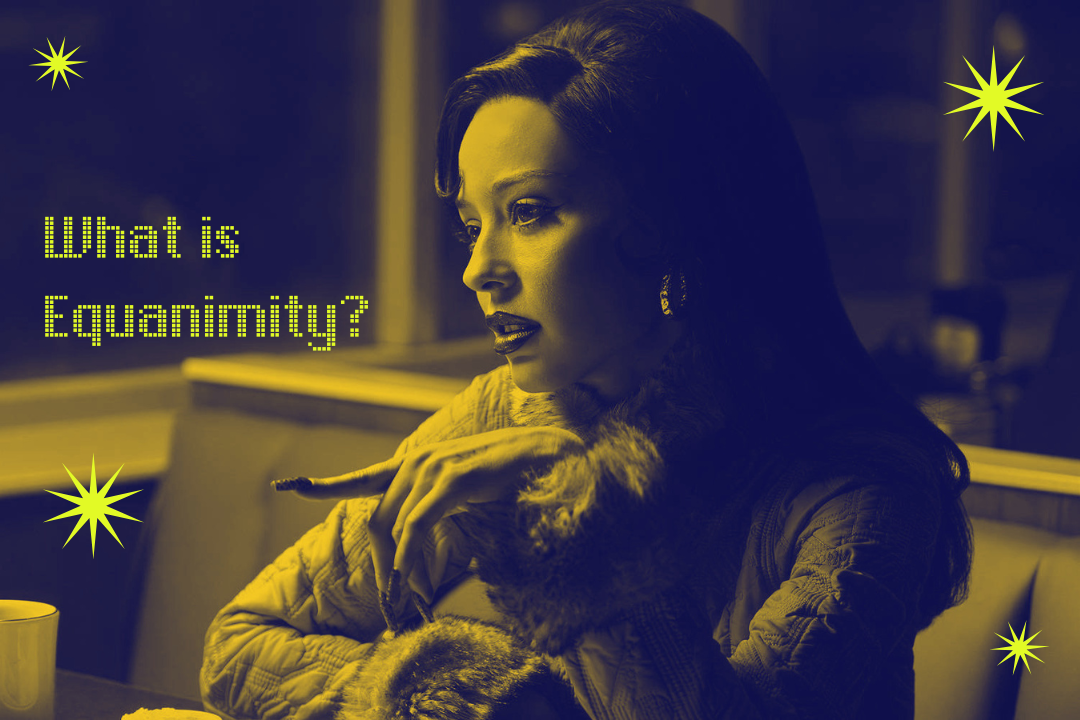
If you watched Euphoria Season 3 Episode 5 ("This Little Piggy") on Sunday and found yourself pausing the screen to Google one word, you were not alone.
Sitting across from Rue in a diner, the iconic (and pretty much main plot line carrying this season, imho) Maddy Perez drops one of the more devastating lines of this entire fever dream of a season: "Equanimity. It’s just the knowledge that everything is exactly as it should be. Like, whether the milkshake I ordered is terrific or terrible….it's all equal."
She follows the reflection with something even more unexpected, especially for the non-esoteric minded: "It all goes back to Jesus. Jesus teaches us to be in the world, but not of the world, right? That's basically what I'm saying."
Season 3, without the sonic guidance of Labrinth, and the unchecked “vision" of Sam Levinson has been, generally received, as a “hate watch” but, Maddy’s arc has kept it interesting.
In her delivery of the “Equanimity” passage, she not only leveled a pedestrian view of objective morality and relatively, but tapped into an ancient concept that spiritual traditions from Tibetan Buddhism to early Christianity have been teaching for thousands of years.
So, how can terrific and terrible be the same? And, what is equanimity, actually? Let’s explore.
Equanimity Does Not Equal Ignorance
I first heard the word, personally, while traveling through Tibet, embarking on the journey of a lifetime as I attempted to complete the kora around Mount Kailash. I simultaneously learned the word as I experienced it. As with most proper initiations, the lesson was not given, it was (most certainly) earned.
The word equanimity comes from the Latin aequanimitas, meaning an even or level mind, but the spiritual concept runs far deeper than what that clinical definition suggests.
Equanimity is not the absence of feeling, nor is it detachment, dissociation, or emotional flatness. But, rather, it is the ability to reconcile all that is paradoxical, and is one of the most radically challenging psychological states a human being can cultivate.
Equanimity, in practice, is the capacity to remain unshaken in the face of pleasure and pain alike, without clinging to one or resisting the other.
Maddy does not say she feels nothing, but, instead, she says she’s reached a state of pure harmony.

Euphoria on HBO
The Tibetan Buddhist Teaching on Equanimity (Upeksha)
In Tibetan Buddhism, equanimity is called upeksha (Sanskrit) or tang nyom (Tibetan), and it is considered one of the Four Immeasurables, which are the foundational qualities a practitioner cultivates on the path to liberation.
The Four Immeasurables are loving-kindness (metta), compassion (karuna), empathetic joy (mudita), and equanimity (upeksha). Each is considered "immeasurable" because, when fully developed, they extend without limit to all sentient beings.
Upeksha is considered the ground from which the other three can operate without burning out. For example, compassion without equanimity collapses into despair. Loving-kindness without equanimity becomes possessiveness. Empathetic joy without equanimity curdles into comparison. Equanimity is the stabilizing force underneath all genuine forms of love and care.
In the Tibetan tradition specifically, equanimity is understood as freedom from bias. The practitioner who has cultivated upeksha no longer divides the world into those who benefit them, those who harm them, and those they ignore. All beings are held in the same field of awareness, with the same openness, the same wish for collective liberation.
The Vajrayana path, whose name translates literally as the Diamond Vehicle, is the tantric branch of Tibetan Buddhism. Tantric in this sense does not mean what Western culture has reduced it to. It refers to a system of practice that incorporates the full texture of human experience, including desire, emotion, and energy, directly into the path of liberation rather than treating those forces as obstacles to be suppressed.
Where other Buddhist paths work gradually through study and ethical refinement, Vajrayana uses the mind's most concentrated energies as fuel. The diamond is the metaphor because a diamond cuts through everything and cannot itself be cut.
The result, as the teachings describe it, is a state of pure harmony…essentially Maddy's exact phrase fully embodied.
What Equanimity Is NOT
Equanimity, in the Buddhist sense is not indifference, and the Pali and Sanskrit texts are explicit about this distinction.
Indifference (upekkha confused with adukkhamasukha) is dull, contracted, and self-serving. True equanimity is expansive and clear, and does not mean you stop caring, but, instead, it means you stop letting your caring be conditional on outcomes going the way you want them to go.
For example, Maddy‘s life is far from perfect. She is an assistant, who, yes, works with celebrities, but is also cleaning up literal dog shit from her bosses office. Simultaneously, she is building an empire from a basement apartment, but she refuses to let the emotional weather of her current conditions and web of relationships destabilize her vision.
"In the World, But Not of the World": What Jesus Actually Meant
When Maddy invokes Jesus, she is quoting one of the more philosophically rich passages in Christian scripture. The phrase comes from the Gospel of John, Chapter 17, in what is often called the "High Priestly Prayer," where Jesus says of his followers: "They are not of the world, just as I am not of the world." (John 17:16)
Jesus is not asking his devotees to withdraw from the world, or to avoid it, and abandon it. He says in the same prayer: "I do not ask that you take them out of the world, but that you keep them from the evil one." (John 17:15)
The call is not withdrawal, but is to a quality of consciousness that can move through the world's obstacles without being governed by them.
To be "of the world," in this sense, means to have your identity, your peace, your sense of self entirely dependent on worldly outcomes like clout, money, relationships (both real and parasocial in modern terminology), or how others perceive you.
To be "in the world but not of it" means to act fully, engage fully, participate fully, while remaining rooted in a mindset/presence/state of being that the world cannot give, nor can it take away.
Christian mystics across centuries have recognized this as an interior state rather than an external one, and similar to Buddhist teachings where there is always an inner, outer, and secret meaning, we can consider the idea of “the Kingdom of God” as a similar concept…something that is within and without, and the work is to reconcile both while being fully present, even in the mundanity and muck of reality.
Stripped away of dogma, deities or esoteric leanings, the TL;DR on the idea is to keep a stable center that does not collapse under pressure, and to remain open and clear and undefended, even in the middle of difficulty.
Why Maddy Gets It (And Why Rue Doesn't Buy It)
Equanimity is not a finish line you cross and then possess forever. In both the Buddhist and contemplative Christian traditions, it is a practice, something you return to again and again as conditions test it.
The Tibetan masters say that the mark of real equanimity is not that you feel peaceful when life is peaceful, because anyone can do that. The hallmark of integrating with this teaching is that you are able to remain stable when something genuinely destabilizing arrives.
So, like, when Alamo walks into that diner and the philosophical becomes immediately, viscerally practical. Rue's life is on the line, but Maddy holds the scene with the same calm she just finished describing. By the episode's end, Rue is buried up to her neck in a hole in the ground. In the world but not of it, sure. Easier said when you are the one still above ground. However, Maddy may, or may not, be working with Alamo by next episode.

Euphoria on HBO
How to Actually Cultivate Equanimity
The Tibetan tradition offers concrete practices for developing upeksha, even for those who have not taken refuge, there’s some important gems here for living in harmony, and navigating the chaos of reality.
The first is the recognition of equality. Every being, the teachings say, has at some point in the vast scope of past lives been your mother, your enemy, your beloved, and a stranger. When you truly feel this, the rigid categories of friend, enemy, and neutral begin to dissolve, and what replaces them is a kind of vast, warm openness.
The second is working directly with reactivity. When something pleasant arises, the practitioner notices the impulse to grasp it, to make it stay. When something unpleasant arises, they notice the impulse to push it away. The practice is not to suppress those impulses but to recognize them as movements of mind rather than commands that must be obeyed. Over time, the lurching decreases, and the ground becomes more stable…no matter the terrain.
The third, specific to Vajrayana, is working with a deity or practice figure whose quality is that of equanimity itself, sitting with that transmission, allowing it to condition the practitioner's own mind and energy system over time. For the uninitiated, you are not worshipping a deity, but, instead you are using one as a mirror. The practice works by keeping focused attention on a quality of mind you want to develop, with mantra and visualization as the tools that allow it to fully integrate within you.
In the contemplative Christian context, the parallel practice is contemplative prayer, or what Thomas Merton called "the prayer of awareness," a practice of resting in the presence of God without agenda, without grasping for a particular experience, without pushing away what arises.
The Scene Captures the Zeitgeist
We are living inside an unprecedented era of overstimulation, emotional dysregulation, and collective anxiety. And right now, two shows are circling the same wound from opposite directions.
Euphoria is getting the OnlyFans and sex work story mostly wrong. It renders it as spectacle and fantastical male-written indulgence. Margo's Got Money Troubles, currently airing on Apple TV+, is getting it profoundly right. Rufi Thorpe's story follows a young single mother who turns to OnlyFans not out of desperation alone but out of survival, and through her creativity she cultivates an emerging understanding of herself as a producer rather than a product.
Here’s where the two shows, and the meta layers of this article intersect.
Margo's OnlyFans persona is called Hungry Ghost, and in Buddhist cosmology, Hungry Ghosts are beings tormented by insatiable craving. Their throats are too narrow to swallow, and their stomachs are never full. They consume endlessly and are satisfied by nothing.

Euphoria on HBO
It is not a coincidence that this is the dominant condition of the attention economy. The scroll that never ends, the body that is never thin enough, never blonde enough, the tits that are never big enough (even with Cassie as whatever the hell that Godzilla opening scene was in this last episode, too). We are never visible enough, and never monetized enough…we are never enough and never will be.
We have built an entire digital civilization on the architecture of the Hungry Ghost realm, and we are all living inside it.
Always hungry. Never satisfied.
But as both the Buddhist and Christian traditions make clear, equanimity is not meant to be a productivity hack. Nor is it a tool for detachment that lets you avoid your emotions. It is the hard-won result of actually showing up to this messy, gorgeous, grotesque, painful and wonderful life, fully, without requiring it to be different than it is.
Everything is as it should be. It's all equal.
That line will sound either profound or, like some kind of spiritual gaslighting, depending on where you are in your own interior development. Perhaps it’s both and also neither. Harmony, amirite?
TL;DR
Equanimity, as the Tibetan Buddhist tradition teaches through the concept of upeksha, is one of the Four Immeasurables: a vast, unbiased openness that extends to all beings without exception and rests on a foundation that conditions cannot shake. And it is, as Jesus articulated in John 17, the interior posture of someone who is fully in the world and therefore no longer controlled by it.
The TL;DR? It is essentially the emotional freedom from no longer oscillating between the grasping and aversion that defines most of our complex and chaotic human experience. Terrific and terrible.
If this episode sent you down a rabbit hole, you are in good company. The word has pointed seekers, and non-expectant seekers alike, toward the same rabbit hole for two and a half thousand years.