Today is Friday, March 13th, 2026.
Six years ago today, on a Friday the 13th, the world as we knew it quietly exhaled its last somewhat "normal" breath. Schools sent kids home, office workers grabbed their laptops, certain they'd be back to work again “soon.” People stared at their phones on subway platforms trying to parse headlines that still felt abstract, like something happening elsewhere, to someone else. And then, slowly, the door closed behind all of us, and we didn't even realize just how much our lives would truly change.
The fact that it happened on a Friday the 13th feels almost too on the nose.
Dates are strange containers, and some of them hold more weight than others. So, let's talk about this one, and why Friday the 13th gets a bad rep, and whether it actually deserves it.
The Superstition Younger Than You Think
If you were to trace the Friday the 13th superstition to its earliest recorded roots, you wouldn't end up in ancient Rome or the mystical East. You'd end up in 19th century France.
The first known written reference linking Friday and the number 13 as an omen of bad luck appears in an 1834 French literary magazine, Revue de Paris, where an author wrote about a Sicilian count who killed his daughter on a Friday the 13th. That same year, a character in a French play declared, with full theatrical might, that he was born on Friday, December 13, 1813, and that from this fact sprang all of his misfortunes.
By the late 1880s, the belief had jumped to the Atlantic. American newspapers started referencing it regularly, sometimes still labeling it a 'French superstition' with a slight eye roll. Then, in 1907, a popular novel called Friday, the Thirteenth by Thomas W. Lawson, in which an unscrupulous Wall Street broker deliberately engineers a market panic on the date, cemented the mythology in the Western imagination. Popular culture did the rest, most memorably in 1980, when a low-budget horror film called Friday the 13th introduced the world to Jason and Camp Crystal Lake. The franchise spawned 12 sequels, a coincidence? I think not.

The fear of Friday the 13th even has a name: paraskevidekatriaphobia (pronounced: par-AS-keh-vee-deh-KAT-ree-uh-FOH-bee-uh)
It's derived from the Greek words for Friday (Paraskevi), thirteen (triskaideka), and fear (phobos). A psychotherapist named Donald Dossey coined the term partly as a therapeutic tool, because his theory was that if a patient could learn to pronounce the word, it would help loosen the fear around it. The paranoia around this date is real enough to have measurable economic impact; estimates suggest businesses lose hundreds of millions of dollars on Friday the 13th from people who simply won't show up, won't travel, or sign contracts.
But the superstition, for all its grip on the Western psyche, is built on two older, stranger, and far more interesting currents: the mythology around Friday itself, and the ancient unease around the number 13.
Why 13? The Mathematics of Dread
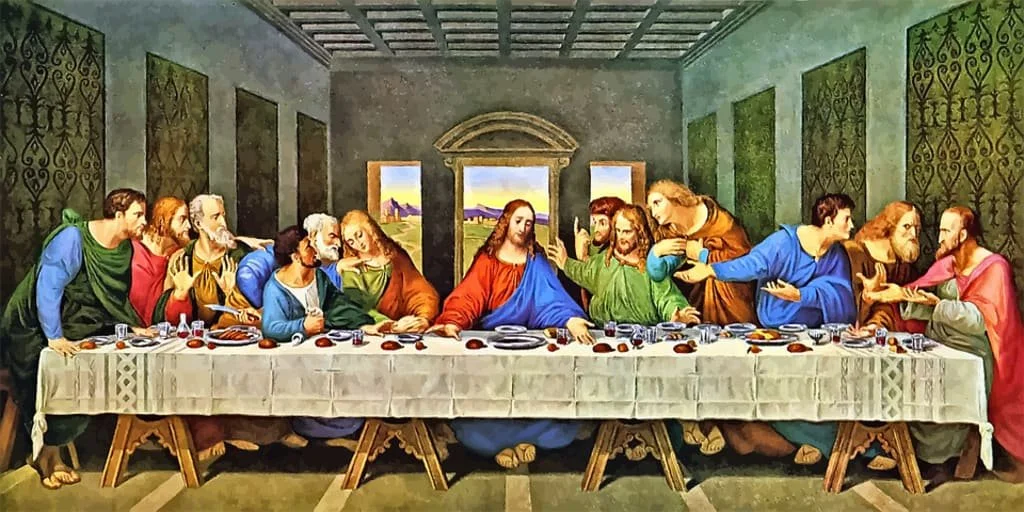
“The Last Supper” by Leonardo DaVinci
Twelve is a number the ancient world loved deeply. There are 12 months in a year, 12 signs of the zodiac, 12 gods of Olympus, 12 tribes of Israel, 12 apostles, 12 labors of Hercules, 12 inches in a foot. Twelve divides neatly by 1, 2, 3, 4, and 6. It is, in the mathematical sense, a harmonious number.
But, then 13 shows up.
As folklorist Jared Winick put it, 13 is, mathematically speaking, 'kind of a dud.' It's prime, divisible only by itself and 1. It doesn't play well with others. It disrupts the even arrangements. Where 12 feels like a closed circle, 13 is the unexpected guest who breaks the symmetry and changes the energy of the room.
That disruption metaphor also has a root in Norse mythology. According to the legend, twelve gods gathered in Valhalla for a sacred feast. Then Loki, the trickster god/chaos agent of the Norse pantheon, arrived uninvited as the 13th guest. Deceiving the blind god Hodr, Loki manipulated him into shooting Balder, the god of light, joy, and goodness, with an arrow tipped in mistletoe. Balder died, and then darkness entered the world thanks to the 13th guest.
The resonance of this story traveled south through Europe, weaving itself into Christian tradition. At the Last Supper, 13 guests sat at the table, Jesus and his 12 apostles. The 13th to arrive, as tradition has it, was Judas, who would betray him before morning. The next day was Good Friday, Jesus’ crucifixion.
The fear of 13 even made it into one of the most beloved fantasy stories ever written. In The Hobbit, published in 1937, author J.R.R. Tolkien wrote a company of 13 dwarves as so unlucky that a wizard recruits an unsuspecting homebody named Bilbo to join the quest and bring the group to 14. Even in fiction, nobody wanted to be the 13th.
Thirteen plus Friday wound up becoming two separate threads of omen, braided together.
The ancient Code of Hammurabi reportedly omitted a 13th law from its list of legal rules, which was most likely a clerical error, but one that later interpreters seized upon as proof of 13's ancient terrors.
Buildings in cities around the world still skip from the 12th floor to the 14th, a quiet architectural testament to how deep this particular irrationality runs.
On Friday, October 13, 1307, when King Philip IV of France ordered the arrest of hundreds of Knights Templar, which was the powerful military and secretive religious order that had accumulated enormous wealth and influence over two centuries. Many were later tortured and executed. Dan Brown's The Da Vinci Code popularized the claim that this is where Friday the 13th got its power, but historians are more a bit more skeptical.
Friday Was Hers First
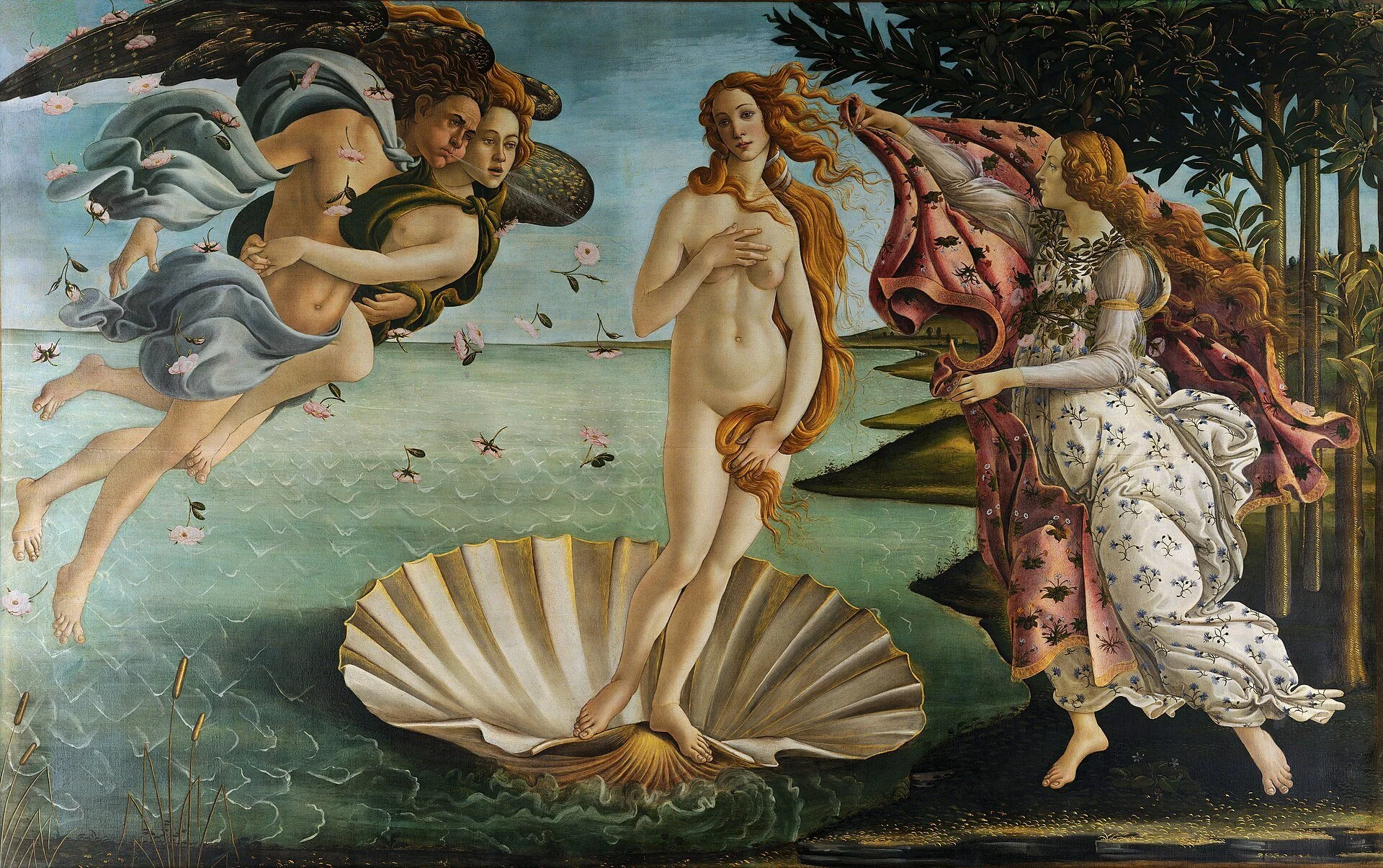
Botticelli’s Venus
Here's the part of the story that tends to get buried, and that feels, to me, like one of the more interesting threads of the legend.
Friday is named for a goddess. The word comes from the Old English Frigedæ, which means 'day of Frigg.' Frigg (also known as Frigga) was the Queen of Asgard in Norse mythology, a sky goddess associated with love, marriage, wisdom, and the sacred arts of weaving. She was the wife of Odin and the highest-ranking of the Norse goddesses. Some traditions also associate the day with Freyja, another Norse goddess of love, beauty, fertility, and magic. In Roman tradition, the equivalent day was dies Veneris, known as the day of Venus. In Spanish, it's still Viernes, and in French, Vendredi.
The goddess is still there, in the etymology of each if you look closely enough.
In many pagan traditions, Friday was considered a particularly auspicious day. It was a day of the divine feminine, of love, of creative power.
Unfortunately, somewhere along the way, through the Christianization of Europe, and the Reformation's deep suspicion of anything that smelled like pre-Christian spirituality, Friday was flipped.
The day of the goddess became the day of the crucifixion, and the day of love and beauty became the day of brutal endings.
In medieval England, public executions were routinely scheduled for Fridays, and in the Canterbury Tales, Chaucer warns against beginning a journey or starting a new project on that day.
And the irony that the most “unlucky” day in the Western calendar was originally devoted to the goddess of love is, honestly, very on-brand for the patriarchy.
The Numerology: What 13 Is Actually Trying to Tell You
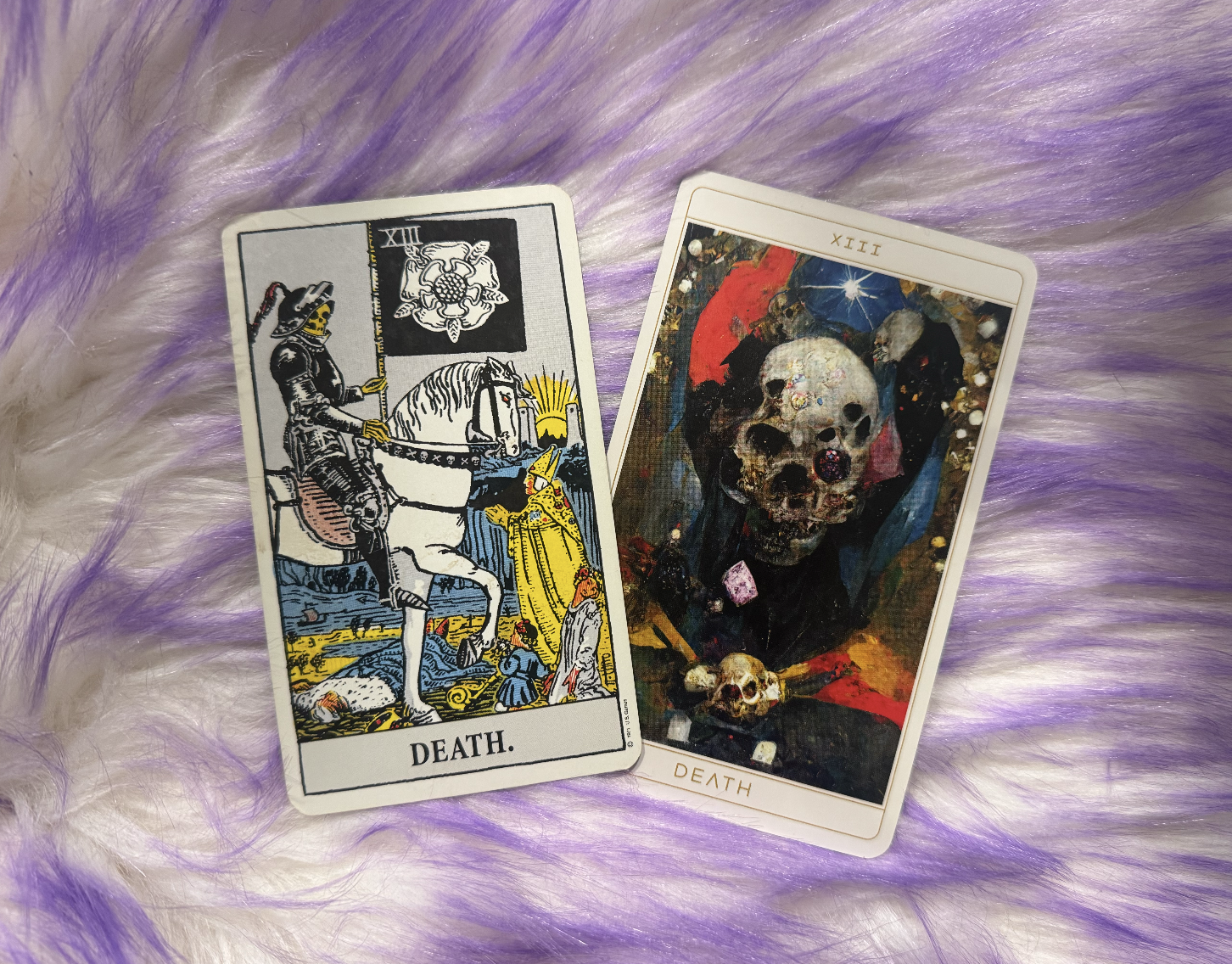
Left: Death Card from the RWS deck | Right: Death Card from The Artist Decoded Tarot
In numerology, 13 reduces to 4 (1 + 3 = 4). Four is the number of structure, foundation, hard work, and endurance. It's the number of the four elements, the four directions, the four seasons, and in Kabbalah, it corresponds to Chesed, the fourth Sephirot on the Tree of Life, representing mercy, loving-kindness, and the energy of expansion and abundance. It is a number of building toward something more, and asks, beneath the surface, for you to consider what you're wanting to construct in the world beyond all the outside noise.
In the Tarot, card XIII is Death, which is a card that is off-putting on the surface, but it’s almost never about literal death. It is, without exception, the card of transformation, transmutation, and of thresholds crossed. It asks you to look at the version of yourself that you have to leave behind in order to become who you're meant to be. The figure on the card rides forward, as the sun rises in the background. It is a symbolic metaphor that endings are often beginnings in disguise, and passages sometimes can feel like “Death,” yet a new life exists on the other side.
It is also interesting to consider that a solar year has 12 months, but approximately 13 full moons. Thirteen is the number of the lunar calendar, the number of cycles in a year if you track time by the light of the moon rather than the Gregorian grid. Many Indigenous and ancient calendrical systems organized time this way. The number 13 is, in this context, not a disruptive guest, but, rather, the heartbeat of a different way of understanding how time moves.
The Friday the 13th That Actually Got Us
On Friday, March 13, 2020, President Trump declared COVID-19 a national emergency, unlocking $50 billion in federal resources and making official what many of us had been quietly sensing for weeks. Something enormous was happening, and we were not prepared for the magnitude of it all.
At the time, there were fewer than 1,700 confirmed cases in the United States.
March 13, 2020 became, in the collective memory, the before and after. As one person on the internet put it recently: “There is the person you were before March 13, 2020 and the person you were after, and they are not the same.”
This once-in-a-generation rupture, this planetary threshold event happened on a Friday the 13th.
You can call that a coincidence, while correctly noting that the virus had already been spreading for months, and the ground was already cracking long before that Friday. But there's something about the symbolism that the rational mind can't fully dismiss or ignore.
The day named for a love goddess, turned omen, became the container for the moment we lost something deep and fundamental within our spirits that we still have yet to reconcile. Not just a sense of normalcy, but a feeling that is much harder to articulate.
Six Years Later, and Here We Are Again
The calendar has folded back on itself. We are standing at the same numerical coordinate, the same day, the same date, six years removed from the moment that split the world in two.
I don't think Friday the 13th is unlucky. Personally, I think it's a threshold through liminality. A date that has been charged, over centuries, with all of our collective anxiety about disruption and terror.
Whatever you're carrying from that Friday six years ago, today is as good a day as any to hold it up to the light and create a new story moving forward.
Not because it's an auspice or an omen, but because the calendar, in its strange recursiveness, has given us a mirror. So let’s reflect on what we wish to see, and create a new vision in the process.